
For a year and a half I was a volunteer at this Frederick, Maryland museum. On Saturdays and Sundays during the Spring and Summer, the museum offers one-hour walking tours called “One Vast Hospital”. I really enjoyed giving these tours and admit my one-hour tours often took upwards of two hours. But I didn’t get any complaints. At least I don’t think anyone complained. And if they did, I didn’t hear them.
Union General George McClellan, commanding the Army of the Potomac, knew there would be intense fighting near Frederick and so did his Medical Director, Dr. Jonathan Letterman. Frederick was the closest large town. When Dr. Letterman arrived, he immediately set to work commandeering and converting 27 buildings into general hospitals. Of those 27 building, 13 were churches.
The battles of South Mountain on September 14, 1862 and Antietam on September 17, 1862 resulted in more than 28,000 casualties (killed, wounded, captured, and missing). Countless soldiers were also sick as disease ran rampant through the Army of the Potomac’s ranks. (Of an estimated 750,000 Union and Confederate deaths during the war, 500,000 of those died from disease.)
Why Frederick?
Frederick was chosen because of its size, about 8,000 residents, a moderate climate and relatively healthy environment, a good transportation network – paved roads and railroads, and quite a few large buildings that could be readily transformed into hospitals.
Visitation Academy
 The school was established by the Sisters of Charity in 1824 and replaced by the Sisters of the Visitation in 1846 and renamed the Visitation Academy. A large addition was added in 1848. At the time of the battle, the school had 47 Sisters and 60 students.
What made this building particularly attractive as a hospital site? There were two large 60’ x 40’ halls that could readily be converted into wards. A third hall measured 40’ x 20’. There were lots of windows to let in sunlight and provide airflow. Thirty other rooms were occupied by hospital staff. In addition, the building had the latest modern conveniences – water pumped up to each floor and gas lights in each room. A kitchen was set up in the courtyard to prepare meals for the patients and staff.
Diagonally across the street was the three story Roman Catholic Novitiate (a training school for Catholic priests), which was built between 1763 and 1848. It also has two large halls measuring 40’ x 33’. This building too had pumped in water and gas lighting. The Novitiate was demolished in 1903 and replaced by four large homes, which are still standing.
A total of 1,565 patients were treated at these two sites. As a privately owned building, the school submitted a list of damages and the cost of repairs to the Federal government and eventually received $3,200 (worth about $66,000 today) in compensation.
The Saint John the Evangelist Catholic church stood across the street from the Visitation Academy. Of the fourteen churches in Frederick, it was the only church that was not used as a hospital.
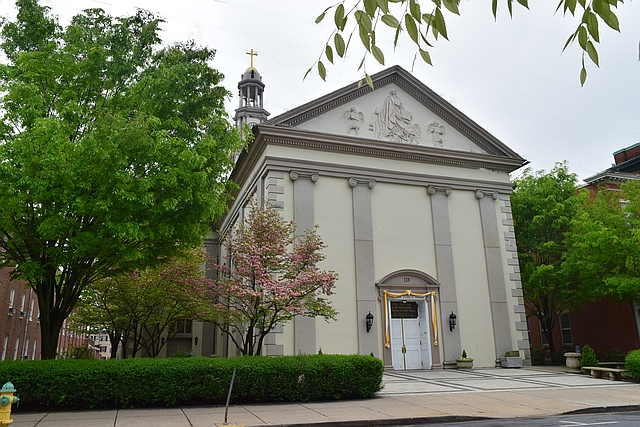
St John the Evangelist Catholic Church
Presbyterian Church
 This church was originally built in 1825. It was remodeled and the vestibule added in 1858.
I had always thought that when a church was commandeered as a hospital, all the pews were dragged outside and possibly chopped up to use as firewood. I was wrong. The pews stayed where they were, boards laid across the pews to form a new floor, and the hospital built on top of that.
What made churches such good choices were that the sanctuaries were very large to accommodate a lot of beds. They also had large windows that could be opened to let in fresh air.
New German Reformed Church
 Although this church was used as a hospital, it was set up in the church’s basement. So, services could be held in the sanctuary. The various Protestant denominations took turns holding services.
The Confederate Army occupied Frederick from September 6 to September 13, 1862. While under occupation, Confederate General ‘Stonewall’ Jackson, a stalwart successionist and very pious man, attended services here. The service was conducted by Rev. Daniel Zacharias, a diehard Union man. During his sermon Rev. Zacharias extolled the Union cause and praised President Lincoln. After the service, the congregation waited for Gen. Jackson’s well-known temper to explode and for him to rebuke the pastor. But nothing happened. Because as soon as the pastor began his sermon, Gen. Jackson promptly fell asleep.
Winchester Hall

The Frederick Female Seminary was founded in 1830 by Hiram Winchester and built Winchester Hall in the early 1840s. Some of the building’s funds were provided through a state-sponsored lottery. His goal was to provide an opportunity for young women to get a higher education.
Like other buildings used as hospitals, this one also had large rooms, a lot of windows to provide fresh air, and could accommodate a large number of sick and wounded soldiers.
After the army evacuated, Mr. Winchester submitted his costs to repair damages. He received $291 (worth about $6,000 today). The government claimed that the school wasn’t privately owned because it was funded, in part, by a state-sponsored lottery. Mr. Winchester argued that it was really a loan that he repaid by providing full scholarships to one woman from every Maryland county each year. Guess who won that argument? That’s right, red tape wins the day…again…and again…and again.
Lutheran Church
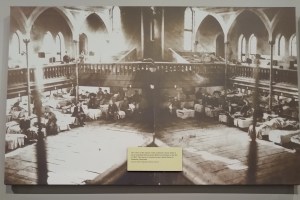
 Sargent Henry Tisdale of the 35th Massachusetts regiment, who suffered a leg wound during the Battle of South Mountain and was recovering here, gave an excellent description of what these hospitals were like.
“A rough board floor was laid over the tops of the pews. Folding iron bedsteads with mattresses, clean white sheets, pillows, blankets, and clean underclothing, hospital dressing gowns, slippers, etc., were furnished us freely. The citizens came in twice a day with a host of luxuries, cordials, etc. for our comfort. The church finely finished off within well-ventilated and our situation as pleasant and comfortable as could be made…”
What else makes this church so special? The only known interior photograph of a Frederick hospital was taken here.
 Final Words

By today’s standards, Civil War medicine was primitive. Concepts regarding what caused disease and how to treat it were often wrong, sometimes dangerously so. Many medicines contained mercury, lead, arsenic, and other dangerous substances. A post-operative infection was expected, desired, and considered to be a sign of healing. A focus on cleanliness had nothing to do with reducing germs and bacteria, but simply to make the air smell good. They got the right answer but for the wrong reason. Yet 92% of the soldiers who were admitted to a general hospital, survived. That speaks volumes to the progress medicine made during the Civil War.
J


 Spirit of the Woods